England
Angela's AshesEngland occupies an unstable place in the McCourt family’s life: it is a nearby source of wartime wages, a possible refuge from Limerick’s deprivation, and the destination that fails to deliver the security the family expects. Malachy McCourt leaves for factory work in Coventry, but the anticipated remittances do not become a dependable means of escape. The contrast between the family’s hopes and what arrives makes England less a settled home than a recurring promise shadowed by separation.
Work and the promise of wages
During the war, English agents recruit Irish men to work in munitions factories. The pay is attractive in a country where jobs are scarce, and families in the lane receive money orders from fathers working in England. Their spending becomes visible in new clothes, better food, cinema visits, and other signs of improved means. Against this backdrop, Malachy agrees to go after Christmas, reasoning that the United States has entered the war and the cause is just. An agent offers plentiful factory work and encourages him to imagine that saving overtime wages could make him rich.
Malachy’s departure creates an immediate expectation of support. Kathleen O’Connell, who runs a local shop, extends credit for tea, milk, sugar, bread, butter, and even an egg because she expects money to come back from England. At home, Angela McCourt and Bridey Hannon picture the wages paying debts, replacing worn clothes and boots, and eventually allowing the family to move to England and then save for America. They also imagine Angela finding factory work there. England thus enters the family’s calculations twice: first as a place to earn money while the children remain in Limerick, and then as a possible next home.
Family separation and failed remittances
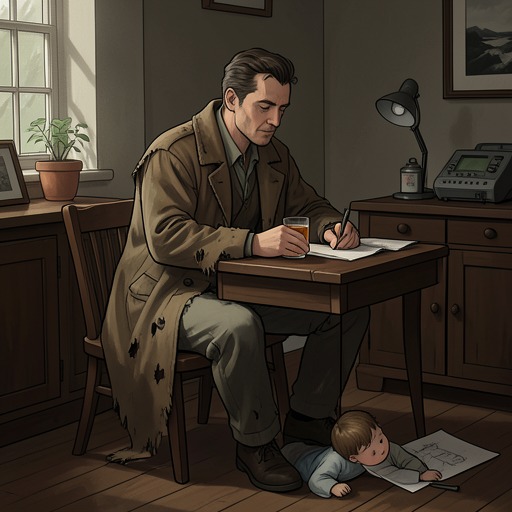
The narrator hopes that the family will eventually go to America, while Malachy initially hesitates to leave. He tells his son that the boy will have to be the man of the house, then signs with an agent for work in Coventry, described as England’s most heavily bombed city. When he leaves, the family expects both his presence to be temporary and his wages to arrive. After he travels back to England following a Christmas visit, he sends a letter telling the children to behave, attend to their religious duties, and obey their mother. A three-pound money order follows, prompting plans for treats and cinema outings.
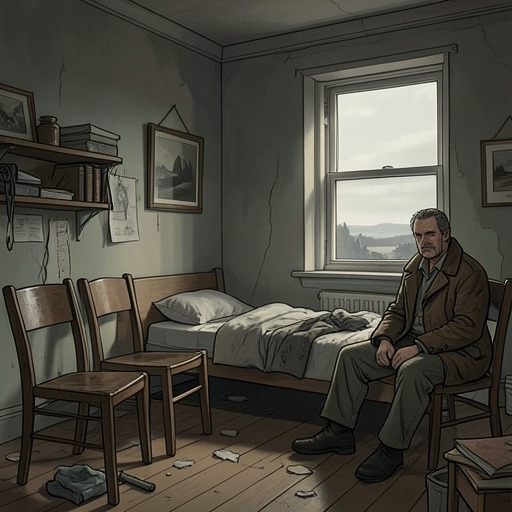
The money order proves exceptional rather than the start of regular support. No further payment arrives on the following Saturdays. The family returns to asking for charity and credit, while Angela struggles with the shame and practical consequences of maintaining the household without dependable income. Reports carried back from England make the failure more specific: Mr. Downes tells Mrs. Downes that Malachy spends his wages in Coventry pubs, often loses his rent money, and sometimes has nowhere to stay after a landlord turns him out. His drinking and conduct also bring him into conflict with local authorities, who may expel him from the country if he continues.
The news reaches Angela through Bridey Hannon at a moment when shop credit is drying up, her mother resists lending money, and the St. Vincent de Paul Society questions her requests for assistance. She considers whether placing her sons in an orphanage might let her go to England to find work and bring them over later. England remains imaginable as a route to a better life, but the evidence of Malachy’s circumstances makes that hope precarious rather than reassuring.
A destination measured against life in Limerick
The family’s expectations of England are shaped by the inequalities they see around them at home. Other households receiving money from England can afford better meals and clothes, while the McCourts sometimes have only bread and tea. Angela tells the children to stay indoors when neighbors boast about food, so they will not have to watch or smell what they cannot afford. Malachy, meanwhile, condemns Irishmen who work for England during the war, associating their wages with English power and with people in Limerick who support the war economy. His refusal to go had been part of this opposition; his eventual departure shows the pressure of unemployment and family need overcoming it.
This difference between political allegiance and material necessity also shapes the household’s view of migration. Angela argues that there is no work in Ireland, that the children’s clothes and shoes are inadequate, and that she would go to England herself if she had the fare. Malachy insists that factory work is not for women. Yet the family’s imagined future depends on the same labor system: his earnings are expected to support them, and Angela imagines earning wages herself if she can join him. England offers a possible exit from deprivation while reinforcing the separation that makes the family’s present more difficult.
The return journey and the wider migration route
Malachy’s brief return for Christmas does not restore the household. When he leaves again, Angela is weak and in bed. He prepares four pieces of fried bread, wraps them in pages of the Limerick Chronicle, and sets out to seek a lift toward Dublin rather than taking the train. The narrator follows him down Barrack Hill and along St. Joseph’s Street until Malachy tells him to go home to his mother and brothers. The departure makes the division between the family in Limerick and the worker in England a physical scene, not merely a financial arrangement.
After Malachy reaches England, a three-pound order raises hopes that are soon disappointed. Later, when the narrator works delivering coal, John Hannon points toward England as one of the places where an Irishman might make money in a factory. He immediately distinguishes that possibility from Malachy’s abandonment of his family. England’s presence in the story therefore recurs through different generations and kinds of labor: the father’s wartime factory work, the mother’s imagined employment, and the advice given to the boy looking beyond Limerick.
The narrator’s own eventual passage is not to England but from Ireland to America. When he has saved enough to leave, a travel agent explains that flying to America would require a costly journey through London; instead, the narrator buys passage on the Irish Oak, sailing from Cork. England is thus part of the practical geography of emigration even when it is not the final destination. Across the family’s experience, it signifies work and possibility, but also unreliable income, broken expectations, and the burden of making a future across borders while loved ones remain behind.